
Never Miss a Winning Move Again.
You know the forks, the pins, the skewers. What slips in real games is the calculation: which moves to check, how your opponent will answer, and where a line really ends. This course trains that process, one session at a time.
- Lifetime accessOne payment, yours to keep
- Self-pacedNo deadlines. Pause any time
- Instant accessStarts right after payment
- Any deviceComputer, tablet or phone
Where the points go
Three moments that lose games.
??
You hang a piece
The position was fine. One move later a piece is gone, and you never saw the reply coming.
?
You miss the win
The winning move was on the board the whole time. You found it afterwards, in the engine.
+− → =
You give it back
You reach a winning position, then let it slip away in a handful of moves.
Three different symptoms. One cause: an unreliable calculation process.
It isn't a knowledge problem
You know the tactics. Calculating them is the hard part.
What most improving players already know
- Forks
- Pins
- Skewers
- Discovered attacks
- Mating patterns
What breaks down in a real game
- Building a short list of candidate moves
- Predicting your opponent's strongest reply
- Judging the position at the end of a line
- Calculating deep enough to trust the move you've found
“What should I calculate here?”
Calculation Foundations is built around that one question, and gives you a repeatable way to answer it.
Calculation Foundations teaches that process, step by step.
Regular price $199Launch price $47Save $152 · 76% off
See what's included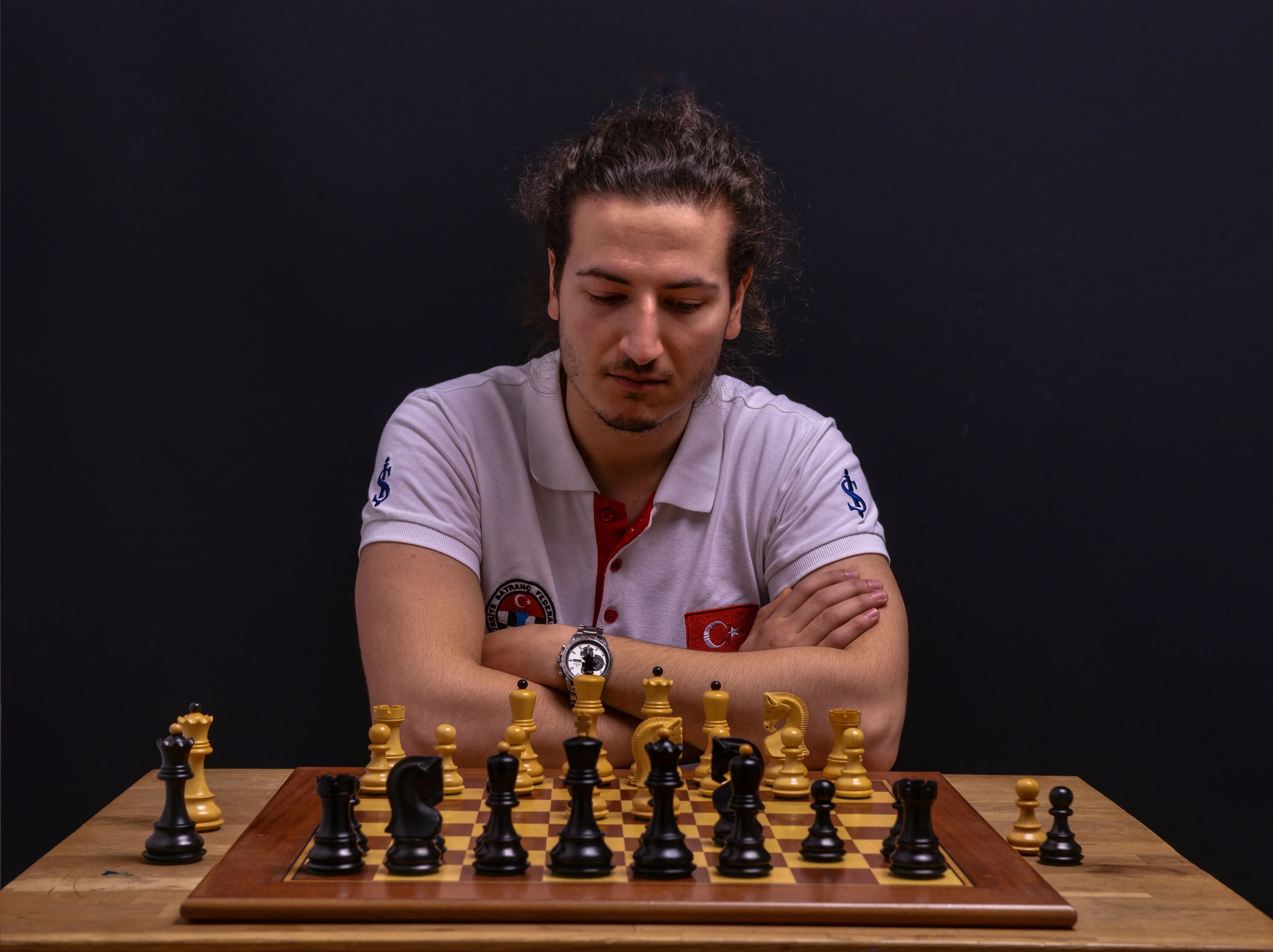
Your instructor
The better you calculate, the better you play.
IM
FIDE title, awarded in 2017
Top 20
rated players in Turkey, 2019
2431
peak FIDE rating
His students include national team players, national medalists and Turkish champions.
I've played competitive chess for close to twenty years and coached for the last ten. With players of every level, I keep seeing the same thing: they study opening lines, traps and memorised ideas instead of calculation.
It works for a while. They surprise an opponent in the opening and win a pawn. Then the first difficult position arrives, they can't calculate it, and the advantage is gone in a few moves.
Opening knowledge can get you an advantage. Calculation is what turns it into a result.
How it works
Every session has one job.
Not a video library, not a puzzle dump. Each session trains a single skill, and every session runs in the same order, so you always know what you're doing and why.
One clear objective
Before you start, you know exactly which skill the session trains, stated in plain words.
A short video
Around four to five minutes. The idea, shown on real positions, without the filler.
Guided positions
Positions chosen to isolate that one skill, with support while you find your footing.
Repeat until it's a reflex
Each pattern comes back again and again, in new positions, until you see it without searching for it.
Feedback on your reasoning
A wrong move gets answered on the board, so you see the refutation, not just a red cross.
A short checkpoint
Show you can apply the method before the next step opens.
Earlier ideas keep coming back in mixed positions, without a label telling you which tactic to look for. That's what makes the skill carry over to your own games.
Try it now
Your move.
Three warm-up positions from the course. They play here exactly as they do once you're inside.
Instant feedback
Every move is checked the moment you play it.
The opponent answers
Play a wrong move and see the reply that punishes it.
Both colours
The board turns around when you play Black.
These are warm-ups. The positions get harder, and the thinking deeper, as you go.

You play White
Take Black's unprotected piece.
Pick up a piece and move it to the right square.
Enjoyed those? The full course builds on them, session by session.
Regular price $199Launch price $47Save $152 · 76% off
See what's includedSection 1 · Calculation Foundations
Unit 1 · Unprotected pieces
Current streak
4days
- Mon
- Tue
- Wed
- Thu
- Fri24
- Sat25
- Sun26
Leaderboard
#3
- 1WWilliam B.2,140 XP
- 2DDiego R.1,985 XP
- 3YYou1,760 XP
Active time
1h 52m
Your dashboard
You always know what's next.
A clear learning path
Sessions open in order, so the next step is never a guess.
Streaks and study time
See the days you trained and for how long. Useful motivation, never a substitute for mastery.
Checkpoints and milestones
Finish a unit by showing you can apply the method, not just by clicking through it.
What you'll train
Everything designed to make you calculate better than ever.
These are the calculation skills the course is built on. Each one is taught, practised and then mixed back in with the others, until they work together as one process at the board.
Unprotected pieces
Loose pieces, targets and threats, on both sides of the board.
Notice what's attackable before you calculate anything.
Candidate moves
Finding the moves worth calculating, and putting them in order.
Build a short, ranked list instead of chasing the first idea.
Forcing moves
Checks, captures and threats, and the replies they allow.
Look at forcing moves first, without ignoring quiet ones.
Thinking patterns
Recurring ideas you learn to recognise on sight.
Spot familiar ideas in positions you've never seen.
Visualization
Following a variation in your head without moving the pieces.
See the position clearly three or four moves deep.
Elimination technique
Rejecting candidates for concrete reasons.
Cross weak moves off quickly, and know why you did.
Comparison technique
Weighing the lines that remain and the positions they lead to.
Choose between the final candidates with a real reason.
Calculation discipline
Checking your conclusion, stopping rules and common errors.
Double-check the critical line and know when to stop.
A baseline assessment at the start and a final assessment on comparable, unseen positions show you what changed, measured on the skill itself rather than promised in rating points.
Why not just solve more puzzles?
Openings get memorised. Calculation gets built.
Still, most players spend far more time on openings than on calculation. They memorise dozens of variations and learn clever traps, which is fun, until the game leaves the book.
Then they reach a winning position and, within a few moves, a calculation mistake gives the whole advantage back.
Sound familiar?
95%
What makes Calculation Foundations different
You can already find
Endless puzzles, one after another
Lichess and plenty of other sites already give you this, for free.
You can already find
Lessons on forks, pins and skewers
YouTube and countless books already explain the themes.
What you get here
A thinking system for finding the right move
IM Serkan Soysal teaches the method and the mindset behind good calculation: unprotected pieces, candidate moves, thinking patterns, elimination, comparison and more.
One goal: give you a reliable way to calculate. It's not another puzzle site, and it's not another video course.
One focused course on the skill that decides most games.
Regular price $199Launch price $47Save $152 · 76% off
See what's includedLifetime access
Buy it once. Come back for life.
Calculation is a skill you keep sharpening. Your access never expires, so whenever your calculation feels rusty, before a tournament, after a painful loss or a year from now, you can come back and retrain. Think of it as an investment in your chess career, not a course you finish and forget.
- Yours for lifePay once and keep it. No subscription, no expiry.
- Retrain anytimeRevisit any skill whenever your calculation needs a tune-up.
- An investmentOne price for a skill you'll use in every game you play from now on.
Calculation Foundations
Launch price · Save $152
Regular price $199Launch price $47
one-time payment · lifetime access
No subscription, no renewals, no expiry.
Get Calculation Foundations- Secure checkout
- Instant access
- Learn on any device
What you get
- Useful core calculation skills, taught in order and mixed together
- Video lessons by IM Serkan Soysal
- Interactive positions with feedback on every move
- Mixed review that brings earlier ideas back
- Baseline, checkpoint and final assessments
- Progress tracking on your personal learning path
- Lifetime access: come back and retrain whenever you want
Live lessons and personal coaching are not part of this course. Other ChessPulse courses are sold separately.
Who it's for
Built for improving players.
A good fit if you
- Know the rules and the common tactical motifs
- Lose points to calculation mistakes in real games
- Want a structured path instead of random puzzles
- Can practise a little, regularly, at your own pace
Not the right fit if you
- Are still learning how the pieces move
- Want live lessons or one-to-one coaching
- Are looking for a guaranteed rating jump
FAQ
Straight answers.
How is this different from solving puzzles on Lichess or Chess.com?
Puzzle sites give you positions to solve. They don't teach you how to think through them. Calculation Foundations teaches a process: what to look at first, how to build candidate moves, how to rule lines out and compare what's left. The positions are chosen and ordered to train that process, and wrong moves are answered so you see why they fail.
I already know forks, pins and skewers. Is this too basic for me?
That's exactly who it's for. The course doesn't spend your time re-teaching tactical themes. It teaches you to find and calculate them in real positions, which is where most players who know the themes still lose points.
What level do I need?
You should know how the pieces move and recognise the common tactical motifs. From there, the course suits anyone who keeps losing good positions to calculation mistakes, from improving beginners to club players.
How much time does it take each day?
A session is a four-to-five-minute video followed by practice, so most sessions fit into 15 to 20 minutes. There are no deadlines: do several in one evening or take a week off, and your progress is saved.
Is it suitable for kids?
Yes, for children who read English comfortably and already know the basic tactics. Lessons are short, the board gives instant feedback, and the dashboard tracks streaks and milestones, which helps younger players stay motivated.
Will this raise my rating?
We won't promise rating points, because ratings depend on more than one course. What we do measure is the skill itself: a baseline assessment when you start and a final assessment on comparable positions you haven't seen.
When do I get access, and for how long?
Right after payment, and it's lifetime access: come back and retrain whenever your calculation needs it, for as long as Calculation Foundations is offered on ChessPulse. It's a one-time purchase, not a subscription. Future courses are sold separately.
Is this live coaching? Can I ask questions?
It isn't live coaching: everything is self-paced, so you train whenever it suits you. If you get stuck on something in the course, email hello@chesspulse.co.
Can I get a refund?
Your purchase gives you immediate access to the complete course. Due to the immediate delivery of digital content, purchases are generally final once access begins, subject to applicable consumer protection laws and Paddle's refund policy. If you have any trouble with your course, email hello@chesspulse.co and we'll help. The free positions on this page are a good way to see whether the method suits you. Details are in our Refund Policy.
Fix the problem underneath.
You can memorise more openings, watch more videos and play more tournaments. If you can't calculate in the critical moment, the same mistakes keep coming back.
- 1.Learn a reliable calculation process.
- 2.Train it on positions chosen for you.
- 3.Look at today's lost games again, and see them differently.
Regular price $199Launch price $47Save $152 · 76% off
Get Calculation FoundationsOne payment · Self-paced · Instant access